
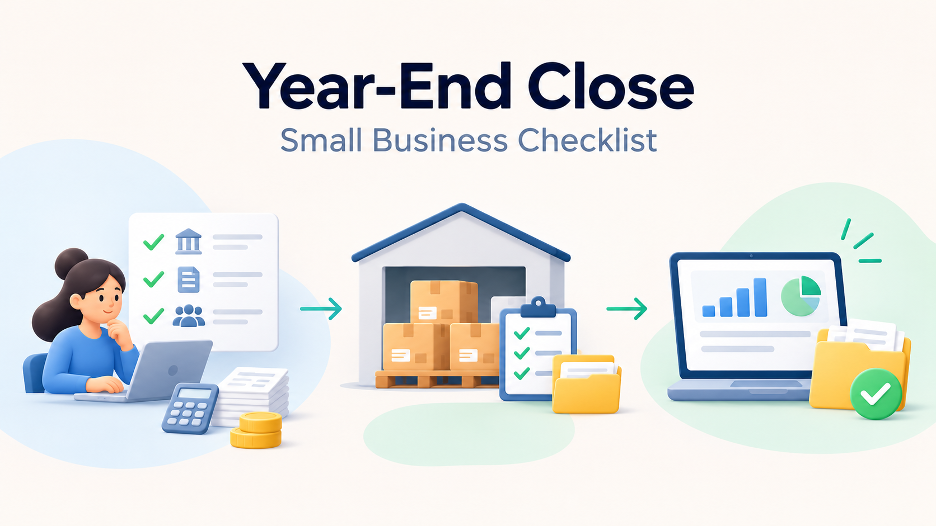
Overview
A year-end close is the last monthly close of the year plus the checks that only happen once a year: a full inventory count, fixed asset and depreciation review, contractor forms, and a file of supporting documents for your tax preparer or auditor. Done well, it takes a few weeks of steady work spread across December and January. Done badly, it becomes a spring-long reconstruction of twelve months of transactions.
Key takeaway: the year-end close is only as hard as the eleven monthly closes before it. If those were skipped or rushed, start the catch-up in November, not in March. For small businesses that want the catch-up and the year-end file handled, Atidiv’s outsourced accounting services bring overdue months current and close the year in QuickBooks, Xero or NetSuite with US GAAP-compliant reporting.
Start in November: the readiness check
Before December, answer four questions honestly:
- Are all twelve months reconciled? Every bank, card, loan and payment processor account, to the statement.
- Is there a backlog? Uncategorized transactions, unmatched receipts, unrecorded bills.
- Do marketplace and store payouts tie out? Revenue in the books should match revenue in the store after fees and refunds.
- Who needs the numbers, and by when? Your tax preparer, an auditor, a lender, or investors in a fundraise.
If any answer is no, schedule the cleanup now. Catching up past months always takes longer than people expect, because every unknown transaction becomes a question someone has to answer from memory.
The year-end bookkeeping checklist
Work through these eight groups in order. Tick items off as you go.
Cash and bank
- Reconcile every bank, credit card and loan account through December 31.
- Reconcile payment processors and marketplaces (Shopify, Amazon, Stripe, PayPal), splitting payouts into gross sales, fees and refunds.
- Clear old uncleared checks and deposits, or investigate them.
- Confirm loan balances and split the year’s payments between principal and interest.
Revenue and receivables
- Review open invoices. Write off what will not be collected, and document why.
- Check revenue cut-off: orders shipped in December belong in December; deposits for January work belong in deferred revenue.
- Record gift card and store credit balances as liabilities, not revenue.
Expenses and payables
- Enter every December bill, even if paid in January.
- Accrue costs incurred but not yet billed: freight, contractors, utilities, professional fees.
- Review prepaid expenses such as annual software and insurance, and expense the portion used.
- Look for personal expenses on business cards and reclassify them.
Inventory and cost of goods sold
- Count inventory at or near December 31, or reconcile your inventory system to a count.
- Value stock at landed cost: product, freight in, duties.
- Write off damaged, expired or obsolete stock.
- Reconcile the inventory balance on the balance sheet to the count, and book the difference to cost of goods sold.
Fixed assets
- List assets bought during the year with dates and invoices.
- Record depreciation for the full year.
- Remove assets sold, scrapped or lost.
Payroll and contractors
- ☐ Reconcile payroll reports to the general ledger for the year.
- ☐ Collect a W-9 from every contractor you paid, if you do not already have one.
- ☐ Prepare 1099-NEC forms for contractors paid above the IRS reporting threshold. Confirm the current figure with your tax preparer, as it was raised for payments made from 2026. Forms are due to recipients and the IRS by January 31.
Equity and owner items
- Record owner contributions and draws or distributions.
- Reconcile shareholder or member loan balances.
Close and lock
- Review the trial balance against last year and against the budget.
- Have someone other than the preparer review the year.
- Issue the year-end profit and loss, balance sheet and cash flow.
- Lock the period in your accounting software so nothing changes after the file goes out.
The audit preparation checklist: what goes in the file
Whether the reader is a tax preparer, an auditor or an investor’s due diligence team, they will ask for the same things. Have them in one folder:
| Item | Why they ask |
| Year-end trial balance and financial statements | The starting point for everything |
| Bank, card and loan statements for December, with reconciliations | Proves cash balances |
| Accounts receivable and payable aging at year end | Supports the balances owed to and by you |
| Inventory count sheet and valuation | Supports inventory and cost of goods sold |
| Fixed asset register and depreciation schedule | Supports assets and the depreciation expense |
| Loan agreements and year-end lender statements | Supports debt and interest |
| Payroll summaries and contractor payments | Supports wages and 1099s |
| Significant contracts, leases and new agreements | Context for unusual entries |
| A list of unusual transactions with explanations | Saves a round of questions |
The last item is the one most businesses skip and the one that saves the most time. A one-line explanation for each large or odd entry answers questions before they are asked.
Before a fundraise: the extra steps
Investors read the same statements with a different eye. Before a raise, also:
- Restate any months where revenue was recorded on a cash basis, so the full year is on an accrual basis.
- Separate one-off costs (a rebrand, a legal dispute) so the run-rate is visible.
- Prepare a monthly profit and loss for the trailing twelve months, not just the annual total.
- Reconcile the cap table to the equity accounts.
How Atidiv helps with the year end
Atidiv’s finance team sets up or repairs the processes the books run on: setup, migration and clean-up in QuickBooks, Xero and NetSuite, and backlog work that brings overdue months current. Every close goes through a three-stage quality check before it reaches you, and the books are kept tax-ready throughout the year, so your accountant or tax preparer gets clean, reconciled books.
For founders preparing to raise, Atidiv’s advisory work covers fundraising support and investor reporting. A typical team is one senior accountant who reviews every close and two junior accountants who do the recording and reconciliation.
Frequently asked questions
Who can help with year-end book closure and audit preparation?
An outsourced accounting team that already runs your monthly close is best placed, because it knows the accounts. Atidiv’s outsourced finance and accounting for D2C brands covers the close, cleanup of backlog months and the reports your tax preparer or auditor will ask for.
When should I start the year-end close?
In November, with a readiness check. If months are unreconciled, the catch-up needs to happen before December 31 so the year-end work is review, not reconstruction.
My books are a mess. Can they be cleaned up before taxes?
Usually, yes, as a fixed-scope project: categorize the backlog, reconcile each month and bring the books current. Atidiv’s bookkeeping services for small business price cleanup and catch-up as a project, separately from the ongoing monthly work.
Do I need an inventory count at year-end?
If you hold inventory, yes. The count, valued at landed cost, is what makes the year’s cost of goods sold and gross margin correct. A system report alone is not enough if it has never been checked against the shelf.
What is the deadline for 1099-NEC forms?
January 31, both to the contractor and to the IRS, for contractors paid above the reporting threshold. The threshold was raised for payments made from 2026, so confirm the current figure with your tax preparer, and collect W-9s in December so the forms are not held up by missing details.
What will an auditor or investor ask for first?
The year-end trial balance and statements, December bank reconciliations, receivable and payable agings, the inventory valuation and the fixed asset register. Having those in one folder, with notes on unusual entries, shortens the process by weeks.