
Everything You Need to Know About Finding Pest Control Lead Sources That Work
Inbound vs. Outbound: Understanding Pest Control Lead Sources
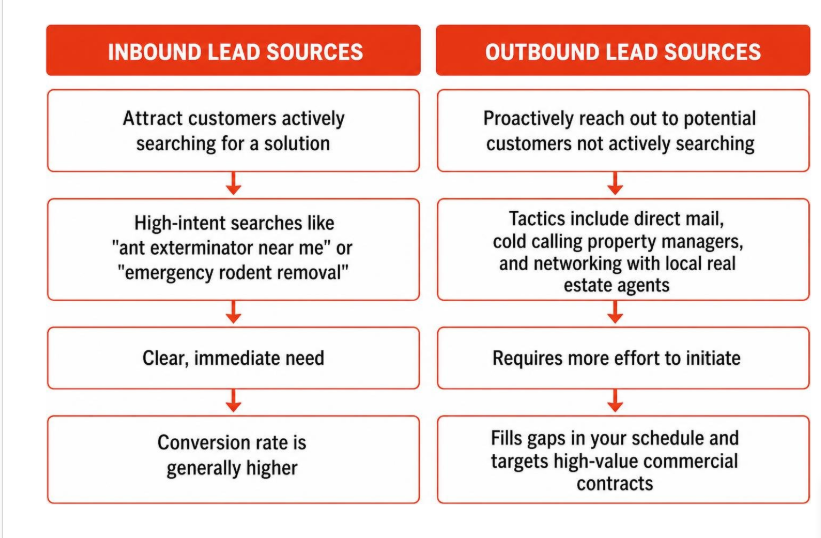
To build a sustainable business, you must balance your lead acquisition strategies. In the pest control industry, this is typically categorized into inbound and outbound tactics. Inbound lead generation is the process of attracting customers who are already actively searching for a solution to their pest problems. These individuals are high-intent, often searching for terms like "ant exterminator near me" or "emergency rodent removal." Because they have a clear, immediate need, the conversion rate for inbound leads is generally higher.
Outbound lead generation, by contrast, involves proactively reaching out to potential customers who may not be actively searching for services at that moment. This includes direct mail campaigns, cold calling property managers, or networking with local real estate agents. While outbound requires more effort to initiate, it is an excellent way to fill gaps in your schedule or target high-value commercial contracts.
Inbound Search and Organic Discovery
Inbound search is the gold standard for long-term growth. When a homeowner discovers your website through a Google search, they are entering your funnel with a high level of trust. By optimizing your site for local keywords, you ensure that your brand appears when a potential client is most likely to book. The key here is to provide clear, actionable information—such as how to identify a specific pest or why professional treatment is safer than DIY methods—which establishes your authority before they even pick up the phone.
Targeted Outbound Outreach and Direct Prospecting
Outbound strategies allow you to control your growth rather than waiting for the phone to ring. For commercial pest control, this is often the most effective path. By identifying local businesses, restaurants, or property management firms, you can tailor your messaging to their specific compliance and sanitation needs. Direct mail, when paired with a clear, time-sensitive offer, can also be a powerful tool for residential neighborhoods, especially when targeting seasonal issues like mosquito control or termite inspections.
Core Digital Marketing Services to Drive Qualified Pest Leads
Generating leads in the modern era requires a cohesive strategy. You cannot rely on a single channel to sustain your growth. A multi-channel approach ensures that even if one source experiences a temporary dip in volume, your pipeline remains full. This is where professional digital marketing services become invaluable. By integrating your organic SEO, paid advertising, and social media efforts, you create a synergy that increases your overall brand presence and lowers your cost per acquisition.
How Integrated Digital Marketing Services Maximize Local Search Visibility
When all your marketing channels work in tandem, you gain a significant competitive edge. For example, your paid search data can inform which keywords you should target with your organic content, while your social media engagement can provide insights into the specific pest concerns currently trending in your community. This integrated approach ensures that every dollar spent on marketing contributes to your long-term authority in the local market.
Local SEO, Google Business Profile, and Citation Management
Your Google Business Profile is arguably your most important asset for local lead generation. It is often the first thing a potential customer sees, and it serves as the primary gateway to your services. To maximize its impact, ensure your Name, Address, and Phone number (NAP) are consistent across all online directories. Regularly updating your profile with high-quality photos of your team and recent customer reviews builds the social proof necessary to convert a visitor into a lead.
Paid Search Advertising: Google Ads and Local Services Ads (LSAs)
Paid search provides the quickest route to visibility. Local Services Ads (LSAs) are particularly effective for pest control because they place your business at the very top of Google, often featuring a “Google Guaranteed” badge that builds immediate trust. Because you only pay per lead, they offer a predictable cost structure. Simultaneously, traditional Google Ads allow you to target specific, high-intent keywords with precision, ensuring your budget is spent on users who are ready to book.
Social Media Marketing and Targeted Retargeting
Social media is less about direct sales and more about brand awareness and retargeting. Many homeowners who visit your site may not book immediately. By using retargeting ads, you can stay top-of-mind, showing them helpful tips or seasonal offers that encourage them to return when they are ready to act. Additionally, participating in local community groups allows you to build a reputation as the local expert, fostering word-of-mouth referrals that cost nothing but time.
Exclusive vs. Shared Leads: Evaluating Cost, Quality, and ROI
The debate between exclusive and shared leads is central to pest control marketing. Shared leads are sold to multiple providers, which often leads to a "race to the bottom" where the first company to call wins the job. While the upfront cost is lower, the lower conversion rates can make them less profitable in the long run. Exclusive leads, however, are sent only to you. While they carry a higher price tag, the higher close rate and ability to build a direct relationship with the customer often result in a much better return on investment.
The Economics of Shared Lead Marketplaces
Shared lead platforms can be useful for new businesses that need to build volume quickly, but they come with significant drawbacks. Because you are competing with other companies for the same lead, your team must be lightning-fast in their response. If you are not the first to reach out, your chances of booking the job drop significantly. This creates a high-pressure environment that can drain your team’s energy and decrease your overall profit margins.
Why Exclusive Leads Deliver Higher Lifetime Value
Exclusive leads allow you to focus on quality rather than speed-to-lead alone. Because you are the only one contacting the prospect, you have the time to ask the right questions, explain your value proposition, and upsell recurring plans. This leads to higher customer retention and a greater lifetime value. When you control the lead, you control the customer experience, which is the foundation of a sustainable, long-term business.
Verification Technology and Real-Time Routing
Modern lead generation relies heavily on technology to ensure quality. OTP (One-Time Password) verification and automated spam filtering help eliminate bots and unqualified inquiries, ensuring that your team only spends time on genuine prospects. By using real-time routing, you can ensure that a lead is sent directly to the right person or CRM, minimizing the time between the initial contact and the booked appointment.
Speed-to-Lead and Conversion Optimization Strategies
In home services, speed is everything. Research consistently shows that responding to a lead within five minutes significantly increases your chances of qualifying that lead. If you wait too long, the customer will likely move on to the next provider. Implementing automated workflows, such as instant SMS replies or automated email follow-ups, ensures that every lead receives an immediate acknowledgement, even if your team is currently in the field.
Fast-Response Workflows and Multi-Channel Lead Capture
To optimize your conversion rates, use pest-specific forms on your website that ask for the type of pest and the property size. This not only helps you qualify the lead but also allows your team to prepare for the job before they even make the first call. By integrating these forms with your CRM, you ensure that no lead falls through the cracks and that every interaction is tracked from the first click to the final invoice.
Selecting the Right Software and Digital Marketing Services for CRM Sync
The ultimate goal is to have your marketing and operations perfectly aligned. By using field-service software that integrates with your lead generation tools, you can automate dispatching, invoicing, and follow-up sequences. This level of automation allows you to scale your business without increasing your administrative overhead, ensuring that your team remains focused on what they do best: providing high-quality pest control services.
Frequently Asked Questions About Pest Control Lead Generation
What is the average cost per lead in the pest control industry?
Costs vary wildly depending on the channel and the level of competition in your specific market. Generally, shared leads from directories are the most affordable, while exclusive, high-intent leads from Google Ads or specialized lead brokers carry a higher cost. It is more important to focus on your cost-per-booked-job rather than just the cost-per-lead.
How quickly should a pest control business follow up with new leads?
The industry standard is to respond as quickly as possible—ideally within five minutes. Using automated systems to send a text or email immediately upon form submission can keep the lead warm until a team member can call them.
Are exclusive pest control leads better than shared leads?
In most cases, yes. While exclusive leads are more expensive upfront, they typically result in higher conversion rates and better long-term customer relationships. Shared leads often lead to price-sensitive customers who are less likely to commit to recurring service plans.
Conclusion
Pest control lead generation is not a "set it and forget it" task; it is a continuous process of testing, tracking, and optimizing. By diversifying your lead sources, focusing on high-intent inbound channels, and prioritizing fast, professional follow-up, you can build a business that thrives year-round. Your goal is not just to get the phone to ring, but to build a sustainable pipeline of customers who value your expertise. With the right strategy and the support of professional digital marketing services, you can turn your lead generation efforts into a predictable engine for growth.