
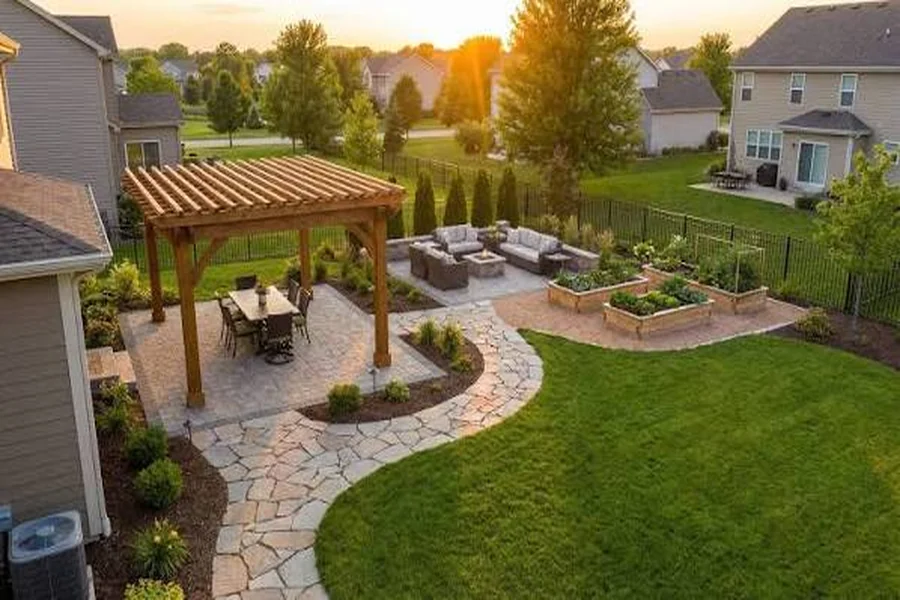
A well-maintained yard is rarely one uniform landscape. Most properties contain broad turf areas, narrow strips along sidewalks, irregular boundaries, planting beds, trees, fences, and other obstacles. Treating every section the same can make routine maintenance slower and can even cause avoidable damage.
The more practical approach is to divide the property into working zones and select lawn tools according to the conditions in each one. A mower that performs efficiently across an open backyard is not necessarily the right choice beside a stone border, just as a string trimmer designed for tight spaces may be inefficient for a half-acre lawn.
Thinking in zones creates a more efficient maintenance system and helps each piece of equipment perform the job it was designed to handle.
Why Different Lawn Zones Require Different Equipment
The main difference between lawn zones is not simply grass height. It is access.
Open turf provides room for larger equipment to maneuver, maintain a consistent cutting pattern, and cover significant ground quickly. Edges require precision because hard surfaces, fences, curbs, and landscaping materials may be only inches away.
Beds and planted areas introduce another challenge: the equipment needs to control vegetation without disturbing ornamental plants, mulch, soil, or root systems.
For homeowners managing several types of terrain, the objective should be to build a complementary tool system rather than search for one tool that can perform every task equally well.
Open Lawn Areas: Prioritize Coverage, Consistency, and Cutting Quality
Large, unobstructed sections of turf are where productivity matters most. A walk-behind mower may be appropriate for many residential properties, while larger lawns can justify a riding mower or zero-turn machine.
The key characteristics to consider include:
- Cutting width
- Adjustable cutting height
- Battery runtime or fuel capacity
- Maneuverability
- Collection or mulching capability
- Terrain and slope handling
Cutting width has a particularly noticeable effect on efficiency. A wider deck covers more ground per pass, reducing the number of passes required over a large rectangular lawn.
However, bigger is not automatically better. If the property contains frequent obstacles, narrow gates, or small disconnected turf sections, excessive mower size can create more maneuvering work than it eliminates.
Match Mowing Height to Turf Conditions, Not Just Appearance
Equipment selection and mowing technique work together. A mower should make it practical to maintain an appropriate height without repeatedly scalping high spots or removing excessive leaf tissue.
University of Minnesota Extension advises removing no more than one-third of the grass blade at a time and emphasizes the importance of sharp mower blades for clean cuts. [1]
That principle matters across different lawn zones because uneven terrain often tempts homeowners to compensate by lowering the deck. A better solution is usually to maintain the appropriate cutting height and address uneven growth through more frequent mowing when necessary.
Lawn Edges: Use Precision Tools Where Mowers Lose Control
Edges are where a conventional mower reaches its practical limits. Narrow strips beside driveways, sidewalks, fences, retaining walls, and garden borders often require a different approach.
A string trimmer is useful for reaching grass that mower decks cannot safely or cleanly access. The goal is not to remove as much vegetation as possible but to create a controlled transition between turf and hardscape or planting areas.
For straight boundaries, an edging tool can create a more defined line. A string trimmer offers greater flexibility around irregular shapes, posts, trees, and other obstacles.
The important distinction is control. At an edge, a few seconds of aggressive cutting can damage bark, expose soil, scatter mulch, or nick landscape materials.
Garden Beds: Choose Tools That Minimize Disturbance
Garden beds demand a lighter touch. Grass growing against ornamental plants may be difficult to remove without contacting stems or shallow roots.
String trimmers should be operated carefully around young trees and shrubs. For very tight spaces, hand tools can sometimes provide more control than powered equipment.
Mulched beds also require attention. A fast-spinning trimmer head can throw mulch several feet, leaving a clean-looking edge but creating additional cleanup.
When working around beds, reduce speed and keep the cutting head positioned so debris moves away from plants whenever practical.
Trees, Fences, and Other Obstacles Change the Equipment Strategy
Obstacles effectively turn an open lawn into a series of smaller working zones.
Trees are a good example. A mower can cover the surrounding turf efficiently, but the final few inches around a trunk may need a trimmer. Repeatedly steering a mower deck close to tree trunks can also increase the chance of bark damage.
Fences create a similar problem. Narrow strips along fence lines may be inaccessible to mower decks, particularly where posts are closely spaced.
A useful setup for obstacle-heavy yards is therefore:
- Mower for the primary turf area.
- String trimmer for inaccessible grass.
- Edger for defined hardscape boundaries.
- Hand tools for delicate planting-bed work.
This division keeps each task relatively simple instead of forcing one machine into unsuitable conditions.
How to Choose Lawn Tools by Zone Before Buying
Before adding another piece of equipment, map the property into three basic categories: open turf, perimeter areas, and planted or sensitive areas.
Then ask four questions:
How much area must the tool cover?
Large areas favor productivity and wider cutting paths.
How close are obstacles?
Frequent obstacles increase the value of maneuverability and compact equipment.
How precise does the task need to be?
Edges and beds generally require more control than open turf.
What surface is underneath or beside the vegetation?
Concrete, stone, mulch, exposed soil, and ornamental plants all require different levels of caution.
This simple assessment often prevents buying equipment based solely on power or advertised size.
A Practical Comparison: One Tool or a Zoned System?
A single versatile machine may appear convenient, but versatility has limits.
For a compact lawn with few obstacles, a mower and a basic trimmer may handle nearly everything. A property with extensive beds, mature trees, fencing, and long sidewalk edges benefits from a broader equipment mix.
Choose fewer tools when:
- The lawn is relatively small.
- Boundaries are simple.
- There are few trees or planting beds.
- Storage space is limited.
Build a more specialized system when:
- Turf occupies a large portion of the property.
- There are many narrow or inaccessible strips.
- Landscape beds have defined borders.
- Multiple tree trunks interrupt mowing paths.
- Appearance standards require crisp edges.
The goal is not to own more equipment. It is to eliminate unnecessary work.
Common Mistakes When Matching Equipment to Lawn Zones
One frequent mistake is using a mower deck to reach areas it was never designed to handle. This often leads to repeated passes, awkward turns, or accidental contact with landscape features.
Another is using a string trimmer as a substitute for edging. Although a trimmer can create an edge, inconsistent cutting angles can gradually widen the turf boundary.
A third mistake is operating powerful equipment too aggressively around beds and trees. Speed does not always equal efficiency when cleanup or plant damage follows.
Finally, neglecting maintenance can undermine otherwise appropriate equipment. Sharp mower blades, properly tensioned components, clean air passages, charged batteries, and intact trimmer heads all contribute to predictable performance.
A Zone-Based Maintenance Routine Saves Time
The most efficient sequence is generally to work from the broadest areas toward the most detailed ones.
Start by mowing the open turf. Next, trim inaccessible grass around obstacles. Finish with edging and detail work around beds and hardscape.
This sequence reduces repeated movement between tools and keeps debris from being redistributed unnecessarily.
For example, mowing after edging may scatter freshly cut grass back across a sidewalk. Completing the broad cutting first and precision work afterward creates a cleaner finishing process.
FAQ: Choosing Equipment for Different Lawn Areas
What tool is best for large open lawn areas?
A mower is generally the primary tool for open turf. The appropriate type depends on lawn size, terrain, obstacles, and desired cutting productivity.
Should I use a string trimmer around trees?
A string trimmer can handle grass near trees, but it should be operated carefully. Avoid striking trunks or exposed roots, as repeated contact can cause physical damage.
Is an edger necessary if I already own a string trimmer?
Not always. A trimmer can manage many lawn boundaries, while a dedicated edger is useful when consistently sharp, defined lines are a priority.
How many lawn tools does an average property need?
There is no universal number. A straightforward lawn may require only a mower and trimmer, while a property with extensive beds, trees, fences, and hardscape may benefit from additional specialized tools.
Should powerful equipment be used around garden beds?
Generally, delicate areas call for greater control rather than maximum power. Lower-risk methods and slower operation can help protect plants, mulch, and exposed soil.
Build the Tool System Around the Landscape
The most useful lawn-care equipment is not necessarily the largest, fastest, or most powerful. It is the equipment that matches the work.
Open turf rewards coverage and consistency. Edges demand precision. Garden beds require control and restraint. Trees, fences, and other obstacles create transitional zones where compact equipment becomes particularly valuable.
Once a property is viewed as a collection of distinct maintenance zones, equipment decisions become much more straightforward. Instead of asking which tool can do everything, ask which tool can do each specific job efficiently and safely. That shift can reduce unnecessary passes, improve finished results, and make routine lawn care considerably more manageable.
Meta description:
Learn how to match lawn tools to open turf, edges, garden beds, trees, and obstacles for more efficient and precise yard maintenance.
Authority references to include with the published article
- University of Minnesota Extension — Mowing Practices for Healthy Lawns: Covers mowing height, the one-third rule, sharp blades, and alternating mowing patterns. University of Minnesota Extension: Mowing Practices for Healthy Lawns
- University of Minnesota Extension — Renovating a Lawn for Quality and Sustainability: Provides guidance on turf conditions, mowing, soil preparation, and lawn-management practices. University of Minnesota Extension: Renovating a Lawn for Quality and Sustainability