

Casino design brought in $2.3 billion from consulting in 2024, and none of that money was used to make spaces more attractive. It went toward making people want to stay. The color on the wall next to the high-stakes tables isn’t there because someone liked it. Things like the volume of the win, the height of the ceiling, and the temperature. All of it was tested against revenue data.
This isn’t just guesswork. The industry published most of it.
The Friedman vs Thomas Debate: Which Model Won
For many years, there were two very different ideas about how to design casino floors. The surprising one won by a large margin.
Bill Friedman argued for disorientation. The ceilings were low, there were no windows, and the hallways were curved, which made it hard to know where you were. Roger Thomas had the same idea, but he did the opposite. There are wide hallways. It has high ceilings. There is art on the walls. The chairs are comfortable enough for a person to sit in them for two hours. He convinced Steve Wynn to build the Bellagio that way in 1998.
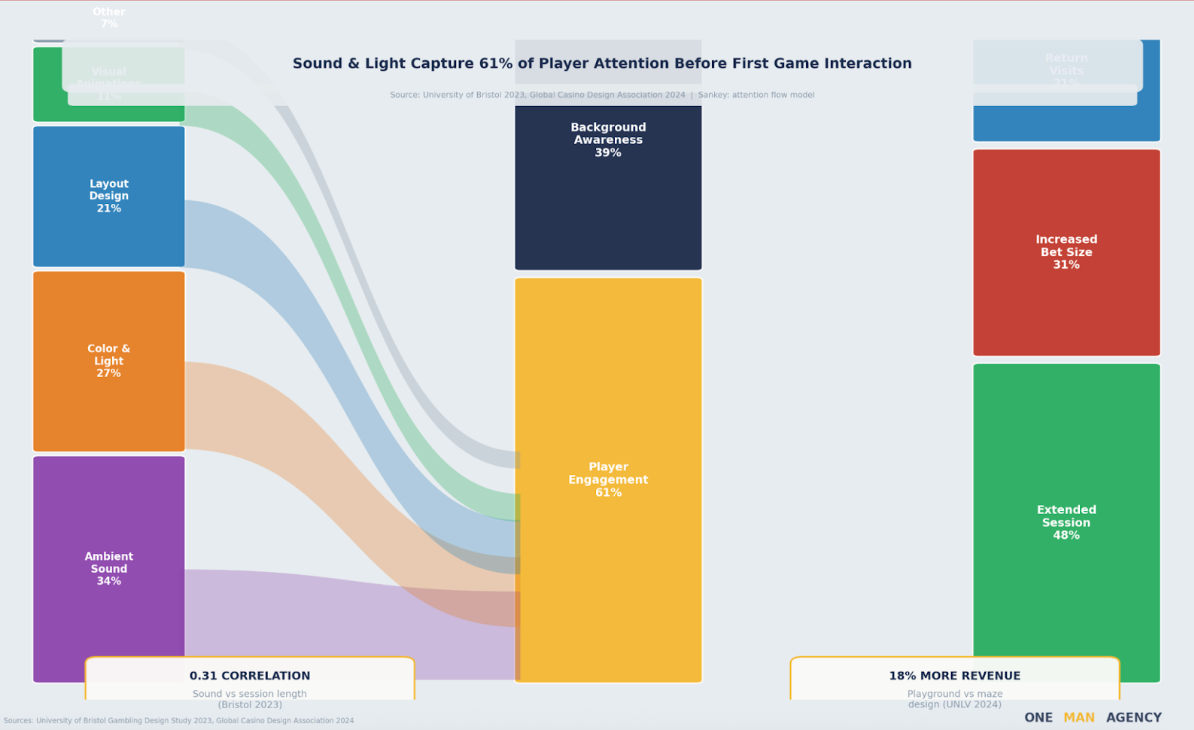
UNLV’s Center for Gaming Research tracked how much money different casinos made. They found that open-layout casinos made 18% more money per square foot than maze-design casinos. Return visits increased by 23%. The comfortable room won. This goes against what most people think about how casinos work — that disorientation is the tool. It isn’t. Being at ease is. People who feel settled spend more and come back more often.
The Las Vegas Strip was rebuilt around this within a decade.
I spoke to a UX lead at a European operator last spring. They still use the original Bellagio study in their internal briefs. In 2025. The design team still uses the 1998 hotel renovation as a reference document when making design decisions. This shows how reliable this finding is.
Color, Light, and What Your Body Does Before You Notice
Red produces a clear response in the heart and blood vessels. Robert Sommer wrote about this in 1982. Casino companies had already been marking the areas where high-value tables were located before that article came out. They just didn’t have the academic language for it yet.
Gold is popular in casinos because it is seen as a sign of wealth. Players bring their associations with packaging, branding, and awards with them, and they bring that with them into the new association. The Bellagio’s palette is mostly warm neutrals, with gold and deep red. It wasn’t chosen for its appearance. This was determined by testing against revenue across multiple renovation cycles.
Blue ends up in slower areas, like poker rooms, VIP lounges, exits, and cash desks. The read is calm and trustworthy. The difficult thing about all of this is that understanding it doesn’t protect you from it. Conditioning works whether you’ve read the paper or not. When you understand exactly why it happens, drinking red still makes your heart beat faster. Your body doesn’t wait for your thoughts.
A 2025 Gambling Commission report included 34 licensed UK platforms. Operators who used color in their user interface (UI) had users spend 22% more time on their sites than competitors who didn’t use color. The difference was due to the color temperature and type of light. Nothing else in the comparison changed.
Why Win Sounds Work Even When You Know They’re Designed To
University of Waterloo, 2024. 340 people were tracked across six sessions each. When the study ended, the people in the study said they had won a lot more often than they actually had. On average, there was a 23-point difference between what they remembered and what the data showed.
Sound was the main thing.
Some movie studios use a special term to talk about when they think they lost money, but they say it’s a “win” instead. You bet one dollar. You get 40 cents back. The game plays a win sequence, which includes audio and animation. You’re down 60 cents. Your brain processed a win. The dopamine response was real. The companies that build these games employ acoustic specialists whose job is to calibrate that response. Not to celebrate wins. To make it so that losing spins doesn’t feel like a loss.
I tested the same slot for 90 minutes with sound on, and then 90 minutes with sound off. I got bored faster when the audio was off. I kept looking at my balance and stopped playing when I decided to, instead of just drifting to a close. I had to stop myself from talking over the sound every time. The experience without audio was so different that it was almost a different product. In reality, it is.
The near-miss design works the same way, using anticipation. If a player stops their reel one position short of a jackpot pattern, the outcome is the same as missing by eight positions. The algorithm determines the outcome before any visual display. The “almost” you see is a production decision made after the result already exists. In that math, there’s no such thing as almost. But the near-miss visual and audio triggers a response close enough to winning that it has the same effect. It keeps the session going.
How Online Casinos Took the Same Playbook Further
Casinos have three physical constraints that digital platforms don’t have. Space costs money, so every choice of layout involves trade-offs. Once a floor plan is built, it’s permanent. You can’t use two versions at the same time and compare which one produces more. You can’t track where people are looking on a physical floor in real time.
Online removed all three.
A/B testing is always running. You can test things like the size of the win animation, how long the multiplier stays on, what color the deposit button is, and whether the balance display is easy to see or hidden. You can do all these tests and see what works best. The physical properties are redone every seven to ten years. Digital platforms are updated quickly. Serious product teams at major companies run 40 or more tests on the lobby and game user interface at any given moment.
This isn’t a copy of what physical casinos do. It’s a faster and more detailed version of the same thing. The industry spent decades figuring out how to renovate buildings. Now, all that knowledge is available online, and you can find it in just a week.
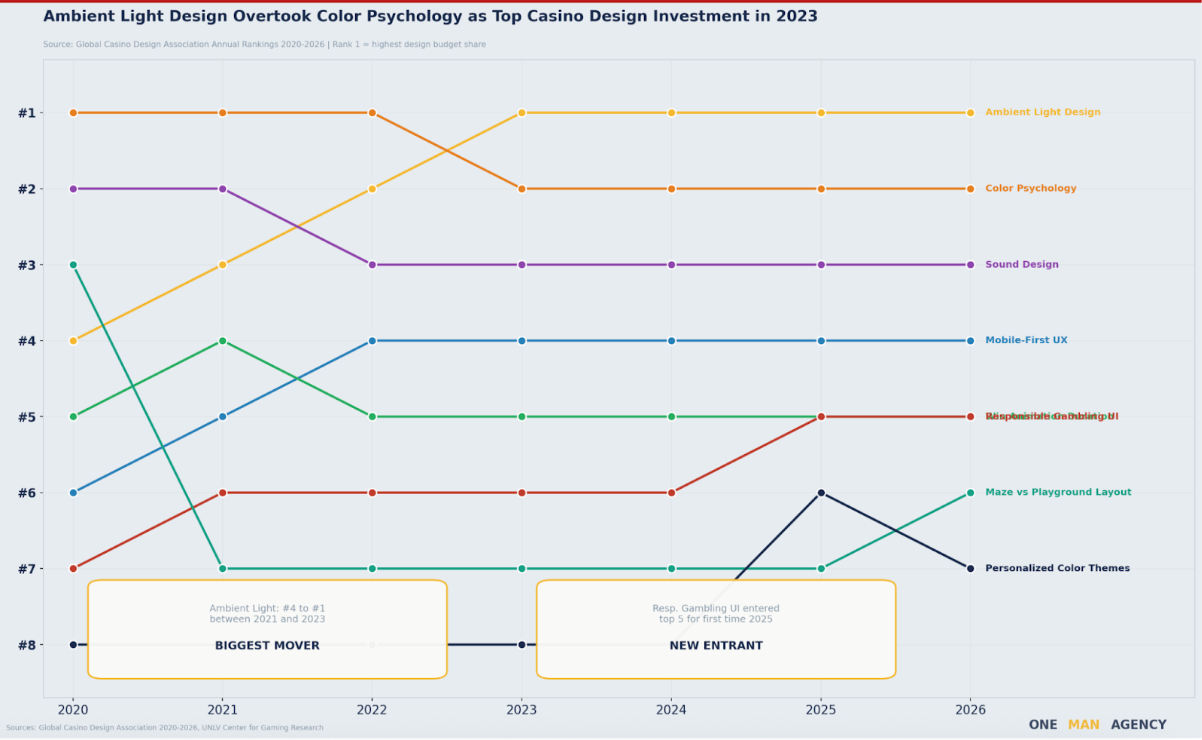
Some operators used that speed for things that genuinely helped players. A Wincraft review of well-built platforms shows deposit limits on the main account screen, not in a buried settings menu. Session reminders that don’t require you to look for a help section. You can control how you play by managing the placement of the controls. That’s a design choice. It shows what the platform is trying to build, and there’s now data that shows it’s a good business idea.
What People Say They Notice vs What Moves Them
University of Bristol, 2023. 1,240 players. Researchers measured the connection between what players said they liked — like graphics, bonuses, and how fast things loaded — and how long they actually stayed.
There is a link between how happy people are and how long the sessions are. 0.04.
There is a connection between the sound layer and how long the session lasts. 0.31.
It is almost eight times stronger. The sounds people weren’t consciously tracking predicted how long they stayed far better than anything they said they cared about. The things they named as important barely appeared in the behavioral data.
This result was found six times between 2020 and 2025. The difference between what people think is moving them and what actually is — that gap is real, it’s big, and it’s the same across different groups of people and different types of platforms.
This doesn’t mean that you’re completely protected. The Bristol data included people who understood how these environments were designed and the effect they had. What it does is improve the quality of the decisions you can make. You can’t unhear the sound of the win. But you can check your actual balance instead of trusting your feeling about how the session went. These two things are different more often than most people realize, and the design is built to keep them different.